
The art of receiving feedback
 Lisa Gill
11 May 2026
Lisa Gill
11 May 2026
Clients often ask us for training on how to receive feedback and we usually hesitate. Why? Because in our experience, if the people giving the feedback are trained in how to give it skillfully – with both empathy and candour – that takes care of 90% of the equation. Having said that, if we want to have a culture of continuous development in our organisations, it certainly helps if each of us is willing to improve our ability to receive feedback. So with that in mind, here are some tips and insights from us based on what we have learned over the last twenty years.
Feedback freaks the brain out
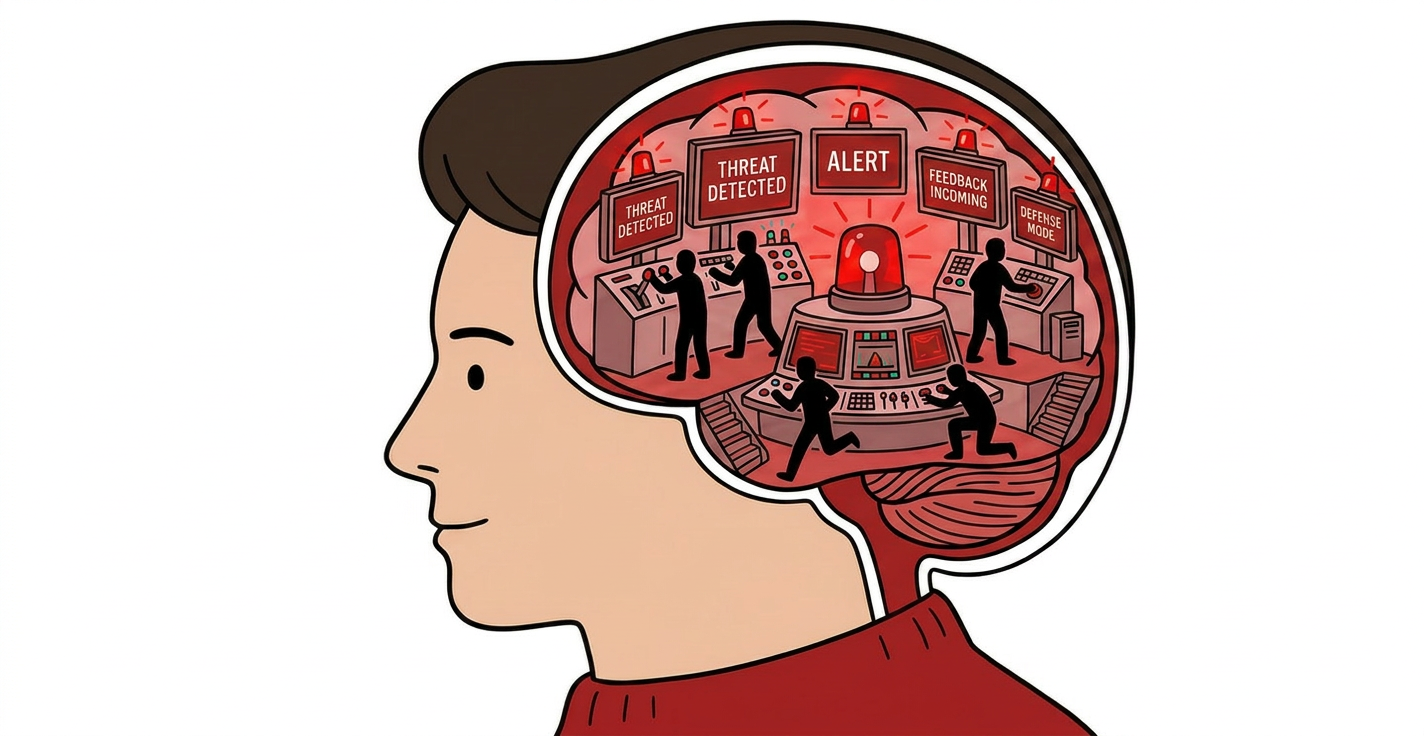
When someone says to you: “Can I give you some feedback?”, what happens? Maybe you get an anxious feeling in the pit of your stomach, or your palms get sweaty, or your heart starts to race. Neuroscientists have discovered that just hearing the word feedback can send us into a panic, like a Pavlovian response. One of the reasons is that our brains actually cannot distinguish the difference between perceived social threats and actual, physical threats. In other words, your brain has the same survival response to “Can I give you some feedback?” as it would in response to “I’m going to punch you in the face!”.
So it’s worth having some self-compassion. Our brains are designed to protect us from threats, and so it’s natural to feel nervous or anxious when you are about to receive feedback. Just having this self-awareness is already a first step in being more conscious in how you respond to feedback.
Three feedback triggers
To go a little deeper, in the book “Thanks for the Feedback”, authors Douglas Stone and Sheila Heen identify three triggers that are often activated in a feedback conversation. They are: The Truth Trigger, The Identity Trigger, and the Relationship Trigger.
The Truth Trigger – when the feedback seems off, unhelpful or just plain untrue. My reaction? Feeling indignant or wronged.
The Relationship Trigger – when the feedback is hard to swallow because of who’s giving it. Maybe I don’t trust them, or I think they’re unqualified to give it. My reaction? Dismiss or diminish the feedback because of who’s giving it.
The Identity Trigger –when the feedback calls into question my whole self-image, i.e. my identity or even core values. My reaction? Feeling overwhelmed, unmoored, threatened, perhaps even ashamed.
When any one of these triggers is activated, our brains go into survival mode which means our pre-frontal cortex shuts down. This is a bit of a problem because if that part of our brain isn’t online, it’s pretty much impossible to actually hear the feedback you’re receiving, let alone start to consider if it’s something useful you want to explore and work on.
It can be helpful to know about these triggers in advance so that you can spot one when it gets set off. Once you recognise a trigger, you can ask yourself reflection questions. For example, if it’s the Relationship Trigger, how might I approach this feedback if someone else gave it to me?
Developing our capacity to consciously receive feedback
In our Tuff programmes, we train people to get consent before giving feedback, and to share something in their verbal invitation about the purpose and intention of that feedback. This gives you a bit of space to choose if it’s a good moment to hear it, and to decrease the likelihood of one of those triggers being set off. Another key ability for feedback givers is to listen so people feel heard so that when someone (naturally) reacts to the feedback, they can support them instead of going into a reactive convincing or arguing mode.
However, the reality is that you will have moments in life where someone gives you feedback in a less-than-skillful way. Sometimes you might be ambushed with feedback that knocks you off your guard, or someone might give it in a harsh or clumsy way. So how can you support yourself to get into a good state? Here are some pointers that might help you at each stage of the conversation.
1. The invitation
Ideally, you are given the option to accept or decline the invitation for feedback. Ask yourself: Is this a good moment? Do I have enough time to have this conversation in a meaningful way? Am I in a good state to receive it? If the answer is no, and you are able to, perhaps it’s better to say: “Can we do it in another moment? It’s not a good time right now” and take responsibility for scheduling the conversation for another time.
The key here is to be conscious. Consenting to feedback means being willing to hear it and consider it. If you don’t have the capacity to do that in this moment, it’s better to be honest. At the same time, if your tendency is to always default to “I’m not ready” or “it’s not a good moment”, is there something you are avoiding? What could help you to have more of a growth mindset? Could you say yes even though you are nervous (and be honest about that)?
2. Choosing a mindset
One of the sources of any of the three triggers mentioned earlier is the feeling of powerlessness; that by agreeing to receive feedback, I’m somehow giving up my agency. A way to reclaim it, then, is by choosing a mindset. Ask yourself: how do I want to relate to this feedback?
For example, I might choose a mindset that whatever the feedback is, I can try to place it in the context of something I, personally, am interested in.
Or, I could remind myself that I don’t have to give up my view. The feedback giver has their view, and I can have mine. Both can co-exist. This mindset is much more likely to help me then consider and be curious about if there is something of value in the feedback, without feeling that I have to surrender my own perspective or ‘truth’ in order to do so.
3. Receiving the feedback message
Now comes the feedback message. If it’s a tough piece of feedback to hear, it might send you into survival mode – fight, flight, freeze, or fawn. One micro-practice that could help you stay present and connected is the MAP tool from Alan Watkins’ book 4D Leadership. It stands for:
Move your attention away from your own thinking and drop into your body and BREATHE;
Appreciate the speaker (which might mean connecting yourself to their positive intent in giving you this feedback, or even saying “Thank you,” even though the feedback is difficult to hear);
Play back the underlying meaning (which can be helpful for both you and the receiver. This might mean summarising back or checking you understand the essence of the feedback message. For example, you could say: “So to check that I understand you correctly, it sounds like your feedback to me is [a summary of their message], is that right?”)
As much as possible, see if you can get yourself into a state of curiosity. This doesn’t mean you have to ‘buy’ the feedback yet, just that you are open to exploring it. Perhaps you could ask clarifying questions, or ask for examples.
4. Choosing your next step
If, despite your best efforts, you still find yourself in a defensive or reactive state, what could you choose? Could you ask for some space to digest? Or perhaps you could share something about what’s going on inside you and ask if the other person can listen to you or hold the space for you while you process?
If you feel in a good place, and you feel you’ve understood the feedback sufficiently, now you can decide what to do next. Is this something you want to take on as a mini development project? Could you ask for some coaching in this? What would you need to take the first step?
Final thoughts
I really believe the key to getting better at receiving feedback is threefold: cultivate self-awareness, accept that developmental feedback is probably never going to feel comfortable, and foster mindsets and practices that will help us make conscious choices about what we do when feedback comes our way. Even better is to be proactive in asking for the sort of feedback you’re interested in receiving, or sharing openly some aspects of your development you’re currently working on – your learning edge.
Sometimes feedback can feel like something that is done to me rather than with me. I would love for us to reframe it as a team sport. If each of us can become more intentional at giving and receiving feedback, and supporting each other in digesting that feedback, we are taking big steps towards truly being a learning organisation.
—
Want to practise how to give feedback that actually lands? Interested in getting lots of feedback about both your qualities and your pitfalls? Sign up for our flagship training programme online or in-person for practical, transformative training in the mindset and skills needed to really master feedback and other key conversations.
Or book a call with someone at Tuff to hear about the bespoke training we offer for organisations that want to upgrade their feedback culture by clicking here.